A deep dive on the Orchestration and Experience plane. Why topology matters more than model choice, why cost and quality live in the shape of composition, and why chat is the prototype rather than the product.
This is the sixth piece in a series on enterprise multi-agent architecture. The flagship laid out five planes and a Trust Fabric. The second piece went deep on the Agent plane. The third on the Model plane. The fourth on the Memory and Knowledge plane. The fifth on the Tool and Action plane. This piece goes inside the Orchestration and Experience plane and stays there. The Trust Fabric closes the series next.
The demo that stopped the meeting
A CIO at a Fortune 500 enterprise walks into a conference room in June 2026 for a demo his team has been building for four months. The team lead opens a laptop. On the screen is a clean, minimalist chat window. The team lead types a natural language request against a familiar workflow. The system takes ninety seconds to think. It responds with a paragraph of prose summarizing what it found and what it recommends. The prose is confident, well-written, and appears accurate.
The CIO reads it twice. He looks at the team lead.
“Where do I approve the actions?”
The team lead pauses. “The system just executes the recommended actions once you confirm in chat.”
“Where do I see what it’s about to do before it does it?”
Another pause. “You can ask it to explain.”
“Where do I see what it did last week? Last month?”
“You can search the chat history.”
“How do I hand this off to my head of procurement so she can review a specific decision?”
“You copy the chat link into an email.”
“How do I know which of the fourteen tool calls it made was the one that produced the wrong number?”
The team lead does not have an answer.
The CIO closes the laptop. The demo that impressed everyone in engineering does not survive first contact with the CIO’s actual questions. The chat is the interface. The chat is the entire interface. There is no plan view, no approval interface, no history that a human other than the original user can navigate, no accountability trail that anyone in the organization other than the team who built it can operate.
The team spends the next quarter rebuilding the experience layer. The model was fine. The harness was fine. The memory was fine. The tools were fine. The topology was under-thought. The interface was assumed rather than designed. This is where most enterprise agent deployments quietly fail in 2026.
The system had all of the intelligence and none of the discipline required to become a product.
The thesis
The Orchestration and Experience plane is where narrow agents compose into outcomes, and where those outcomes meet humans. It is where architecture becomes product.
Its core value is threefold. Topology fits the task, because the shape of the composition determines cost, latency, failure modes, and quality more than any individual model choice inside it. Cost and quality are architectural properties, not model properties, because the same models in different topologies produce different economics and different outcomes. The experience matches the nature of the work, because chat is a demo, delegation is a product, and enterprises that ship the demo without designing the delegation stop shipping shortly after.
Security lives here too, but as a facet of “topology fits the task” and “the experience matches the work.” Audit trails, blast-radius policies, human approval points, and observability are shape decisions on this plane, not add-ons. Everything you built on the four planes underneath (the reliable harness, the substitutable model portfolio, the typed memory stores, the disciplined action surface) either produces value on this plane or does not.
The rest of this piece defends each of the three properties and shows what they mean architecturally.
What changed in 2025 and 2026
Six inflection points reshaped what serious looks like on this plane.
Anthropic published its production orchestration architecture. The multi-agent research architecture behind Claude’s Research feature is now the most documented production orchestration pattern in the field. A lead agent (Opus 4) plans and coordinates. Three to five subagents (Sonnet 4) explore independent directions in parallel. Findings return through a shared memory store rather than through chat-style handoffs. A separate citation pass reconciles the synthesis. The internal evaluation showed a 90.2 percent improvement over single-agent Opus 4 on the research benchmark. The token cost was roughly 15 times a standard chat interaction. That trade curve is now the reference model that every other production team is measuring itself against.
The framework landscape consolidated. LangGraph became the production standard for stateful, auditable multi-agent workflows in early 2026, surpassing CrewAI in GitHub stars and dominant in enterprise references. Microsoft Agent Framework 1.0 reached general availability on April 3, 2026, unifying AutoGen and Semantic Kernel into one SDK with native MCP and A2A support, first-class C# alongside Python, and long-term Microsoft support commitments. OpenAI Agents SDK replaced the experimental Swarm as OpenAI’s production path. Google shipped ADK 1.0 for Java and Go early in the year. Anthropic’s Claude Agent SDK started drawing subscription usage from a separate monthly Agent SDK credit on June 15, 2026. The framework choice matters more than it did a year ago because the frameworks have crossed the durability threshold. It also matters less than the topology choice above it.
The topology mattered more than the model. Princeton’s HAL benchmark data showed that Claude Opus 4 scores 64.9 percent on GAIA inside one orchestration scaffold and 57.6 percent inside another. The gap between two orchestration choices on identical models is larger than the improvement between many frontier model releases. In practice, this means that the team that picked the right topology and the wrong model outperforms the team that picked the right model and the wrong topology.
The 2026 default became supervisor. Across current framework and pattern surveys, the supervisor pattern (a single orchestrator delegating to specialized subagents, one layer deep) is the production default. Anthropic’s research architecture uses it. LangGraph’s Supervisor template uses it. OpenAI Agents SDK handoffs converge on it. Claude Code subagents are architected around it. The reason is empirical: two layers of orchestration (orchestrator plus workers) handle the vast majority of enterprise cases, and adding more layers introduces coordination overhead that rarely pays for itself. The most common production mistake is stacking hierarchy before the complexity of the problem earns it.
The experience conversation broke open. For most of 2025, the discourse assumed chat was the interface. In the first half of 2026, that assumption collapsed under the weight of production experience. NN/g’s State of UX 2026 report named trust as the central AI design challenge and identified the “hybrid trap” (chat and GUI fighting for control) as one of the top adoption killers. The shift from conversational UI to delegative UI (users assigning goals rather than typing prompts) became the design consensus. Generative UI (interfaces drawn in real time from context rather than hard-coded per workflow) moved from research demo to shipping product. Gartner projected 40 percent of enterprise applications will embed task-specific agents by end of 2026, up from under 5 percent in 2025.
Human-on-the-loop replaced human-in-the-loop as the enterprise pattern. The 2024 discourse assumed a human would approve every consequential agent action. The 2026 practitioner consensus is that this scales poorly and produces approval fatigue that erodes the quality of oversight. The pattern that shipped is supervision: humans watch aggregates, intervene on exceptions, approve the classes of action that warrant it, and let the agent operate autonomously on the classes that do not. Microsoft Copilot Studio’s advanced approvals feature is the visible edge of this. The underlying discipline is picking approval points by risk tier, not by default.
Six shifts. One direction. The Orchestration and Experience plane went from an underdesigned afterthought eighteen months ago to a first-class engineering discipline with named frameworks, named patterns, and named consequences.
Topology fits the task
Six topologies dominate the 2026 production landscape. Each has a distinct cost profile, failure mode, and set of tasks it is appropriate for. Confusing them is the most common mistake I see.
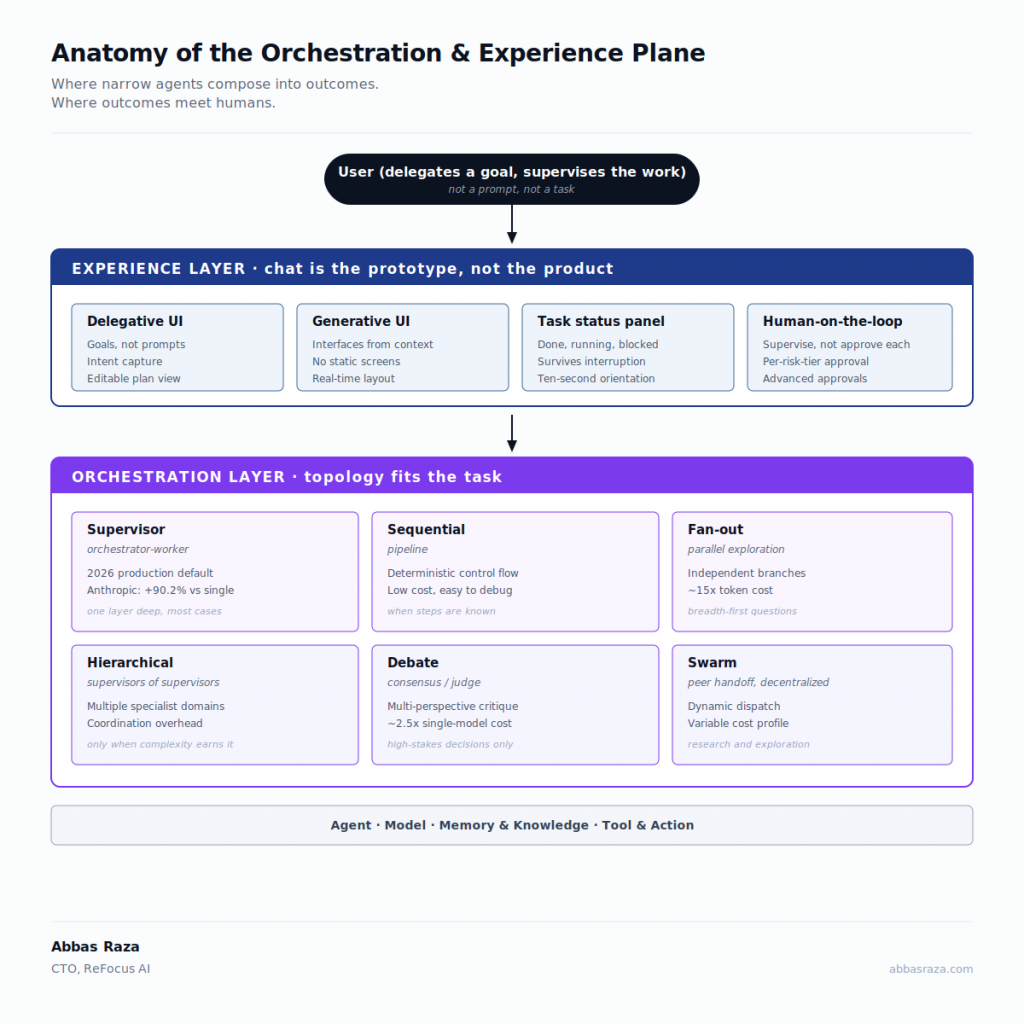
Supervisor (orchestrator-worker). A single orchestrator decomposes the task, delegates to specialized workers, and synthesizes the result. One layer deep. This is the 2026 production default. The Anthropic research architecture uses it. LangGraph’s Supervisor template uses it. It fits any workflow where a coordinator can plan and a set of specialists can execute in parallel or in sequence under coordination. Cost profile: dominated by the orchestrator’s growing context window as it accumulates worker results. Failure mode: the orchestrator becomes a bottleneck and a single point of context corruption.
Sequential (pipeline). A fixed chain of agents, each producing structured output that becomes the next agent’s input. Deterministic control flow. Low cost. Excellent debuggability. Fits workflows where the steps are known in advance and the branching is minimal: intake, extraction, classification, transformation, delivery. Cost profile: the sum of the individual agent calls, no orchestration overhead. Failure mode: rigidity. Any workflow variation outside the pipeline shape requires either a new pipeline or a wrapper.
Fan-out (parallel exploration). The orchestrator spawns N workers in parallel, each exploring an independent branch, and reconciles their outputs. This is the pattern behind the 90.2 percent Anthropic result. Cost profile: roughly 15 times a single-agent chat because you are running N context windows in parallel. Quality profile: excellent on breadth-first questions where the value of the outcome outweighs the token cost. Failure mode: false parallelism. If worker B’s task actually depends on worker A’s result, running them in parallel becomes expensive serial execution with extra overhead.
Hierarchical. Supervisors of supervisors. A top-level orchestrator delegates to mid-level supervisors who delegate to worker agents. Cost profile: high, because every layer adds coordination and context passing. Quality profile: worth it for genuinely complex workflows that span distinct domains, each with its own specialist supervisor. Failure mode: hierarchy added too early. Two layers handle most enterprise cases. Adding a third rarely pays for itself and introduces debugging pain that compounds.
Debate (consensus). Two or more agents produce independent analyses on the same input, and a judge model arbitrates. Microsoft Copilot Council is the reference public example, running GPT-5.4 and Claude in parallel with a judge model deciding between them. Cost profile: roughly 2.5 times a single-model call. Quality profile: valuable for high-stakes decisions where the cost of a wrong answer justifies the cost of running the analysis twice. Failure mode: cost creep. Once teams see the quality improvement they are tempted to apply the pattern everywhere, and the token cost stops being defensible.
Swarm (mesh). Peer agents hand off to each other directly, without a central orchestrator. Decentralized routing. Fits research tasks with dynamic dispatch, or coordination problems where the shape of the work is not knowable in advance. Cost profile: variable and hard to predict. Failure mode: coordination collapse. Without a supervisor to hold state, complex swarms can lose coherence in ways that are painful to debug.
The architectural discipline is picking the topology that fits the task, not the topology that fits the framework or the trend. Real production systems combine patterns. A common architecture: a supervisor at the top delegating to fan-out research workers, feeding into a sequential pipeline that produces a structured output, with a debate step gating the highest-stakes decisions and human-on-the-loop supervision above the entire flow. The patterns are composable. What matters is knowing which pattern operates at which layer, and why.
The most consequential decision on this plane is not which framework to use. It is which topology to build for.
Cost and quality are architectural properties
The empirical case for treating topology as architecture rather than as an implementation detail is now sharp enough to end the debate.
Anthropic’s published data on their research architecture is the most cited: multi-agent Opus 4 plus Sonnet 4 subagents beat single-agent Opus 4 by 90.2 percent on their internal research benchmark, at roughly 15 times the token cost. Token usage explains 80 percent of performance variance on browsing evaluations. This is not a model story. It is a topology story. Same models, different topology, radically different outcome.
The Princeton HAL benchmark result is the second reference point. Claude Opus 4 scores 64.9 percent on GAIA inside one orchestration scaffold and 57.6 percent inside another. That is a 30-percentage-point range on identical model weights, produced entirely by how the orchestration around the model is designed. Framework choice moves benchmark scores more than most frontier model releases. Topology choice moves them more than framework choice.
The practical implication for a CTO is that most of the leverage on cost and quality in an enterprise agent system lives on this plane, not on the Model plane. If you are optimizing your Model plane for cost and skipping the topology discussion, you are optimizing the wrong variable. If you are running debate patterns on low-stakes queries because your team thought the quality improvement was worth it, you are burning money that should be moving to fan-out patterns on the queries where breadth actually matters. Every topology has a right kind of task, and the cost profile is defensible only when the task fits.
Three operating rules that have earned their place:
Match the topology to the task, not the reverse. A supervisor pattern where a sequential pipeline would have worked is expensive misdirection. A debate pattern on a routine query is expensive theater. A fan-out pattern where a single agent could have answered in one call is expensive dilution. The starting question is what the task shape actually is: linear, branching, breadth-first, high-stakes, or research.
Measure the token cost of the topology, not just the model. The supervisor’s growing context window drives more of the unit economics than the worker calls do. The parallel branches in a fan-out drive more than the model per branch. Instrument this. Report cost per outcome, broken down by orchestration layer. The reports will tell you when the topology has grown beyond the value it produces.
Cap the layers. Two-layer orchestration (supervisor plus workers) handles the vast majority of enterprise cases. Three layers requires a specific justification. Four layers requires an unusual justification. The teams that ship reliably in 2026 tend to stop adding hierarchy before complexity accretes past the point of debuggability.
The framework and platform landscape
If the topology is the architecture, the framework is how you express the architecture. The 2026 framework landscape has consolidated around a small number of serious options, and picking between them is real work but secondary to picking the topology.
LangGraph is the production standard for stateful, auditable multi-agent workflows in 2026. It models agent workflows as directed graphs with typed state, checkpointing, and time-travel debugging. It is the framework I see most in enterprise references, in regulated industries, and in serious build-your-own orchestration efforts. Its main trade-off is a learning curve on the graph state model. Once teams internalize it, they rarely leave it.
Microsoft Agent Framework 1.0 shipped GA on April 3, 2026 as the unified successor to Semantic Kernel and AutoGen. Native MCP and A2A. First-class C# alongside Python. Tight Azure AI Foundry, Azure OpenAI, and Entra ID integration. If you are a Microsoft-shop enterprise, this is the framework that will get institutional support first.
OpenAI Agents SDK replaced Swarm as OpenAI’s production path. Clean handoff model, low learning curve, tight integration with OpenAI’s hosted tools. Trade-off: model-locked to OpenAI, no built-in checkpointing for long-running workflows, and the handoff pattern becomes unwieldy past eight or ten agents.
Google ADK shipped 1.0 for Java and Go alongside Python and TypeScript in early 2026. Strong Vertex AI integration and A2A Agent Cards for cross-team agent discovery.
Claude Agent SDK is Anthropic’s production SDK, integrated natively with MCP and the strongest ecosystem support for the “give the agent a computer” pattern. Started drawing a separate monthly Agent SDK credit on June 15, 2026.
CrewAI remains the fastest path from idea to working multi-agent prototype (roughly two to four hours). Trade-off: teams eventually outgrow the role-based abstraction for production workflows.
Above the framework layer sits the managed platform layer. If you need governance, identity, audit trails, and procurement-friendly licensing more than you need code-level control, the eight enterprise platforms that matter in 2026 are Microsoft Copilot Studio and Microsoft 365 Agents, AWS Bedrock AgentCore, Google Vertex AI Agent Builder, OpenAI Agent Platform, Salesforce Agentforce 360, ServiceNow AI Agents, IBM watsonx Orchestrate, and UiPath Agentic Automation. Most large programs I see run both layers: a managed platform for breadth (identity, audit, procurement) and a framework for the depth workflows where the topology genuinely matters. The build-vs-buy question is real, but the answer is usually both.
Roughly 28 percent of production multi-agent deployments in 2026 use custom orchestration rather than a framework. That number is neither an endorsement of custom nor a criticism of it. Custom is right when you have unusual observability or state requirements that no framework meets. Custom is wrong when you are avoiding a framework because the team has not internalized graph state or the handoff model. Learning the framework is cheaper than building the framework.
The experience matches the work
Everything above this section is orchestration. What follows is where the composed system meets humans. This is where most enterprise agent programs discover, uncomfortably, that they built the intelligence and did not design the delegation.
Chat is a prototype. Chat is where teams demonstrate that the intelligence works. Chat is where users learn what the system can do. Chat is not, for most enterprise workflows, the shape of the product.
The 2026 shift is from conversational UI to delegative UI. Conversational UI waits for the user to type a question and returns an answer. Delegative UI accepts a goal, shows the plan, executes the plan under supervision, and reports back with structured outputs the user can act on. The user is not a prompter. The user is a supervisor.
Four patterns anchor the discipline.
Delegative UI. Users assign goals rather than tasks. The interface captures intent in structured form (a form, a wizard, a bounded input flow) and lets the agent decompose the goal into tasks. The user does not type “Please compare these three vendors and produce a recommendation.” The user selects three vendors, picks a recommendation type, chooses a deadline, and delegates. The agent takes it from there. This shift is not cosmetic. It changes what the user thinks the system is: a colleague to whom work is delegated, not a chatbot to whom prompts are addressed.
Generative UI. Interfaces drawn in real time from context, rather than hard-coded per workflow. When the agent needs to show a comparison, the UI generates a comparison view. When the agent needs to show a timeline, the UI generates a timeline. When the agent needs to show a plan, the UI generates a plan view with the specific steps, the current status, and the expected completion. Jakob Nielsen’s framing, quoted throughout the 2026 design discourse, is that “the concept of a static interface where every user sees the same menu options, buttons, and layout, as determined by a UX designer in advance, is becoming obsolete.” The shift is happening now, unevenly, but the direction is clear.
Task status panel. A single view that shows what was done, what is running, what is blocked, and what is next. It survives interruption. A user who steps away for two hours can come back and see the state of the work without scrolling through conversation history. This is one of the highest-leverage patterns in the entire experience layer. Teams that build it report immediate adoption gains. Teams that assume chat history serves the same purpose learn otherwise the first time a user comes back to a long-running task and cannot find the state.
Human-on-the-loop supervision. The 2024 discourse assumed human-in-the-loop meant a human approves every consequential action. The 2026 practitioner consensus is that this scales poorly and produces approval fatigue that erodes the quality of oversight. The pattern that shipped is supervision: the human watches aggregates, intervenes on exceptions, approves the classes of action that warrant approval, and lets the agent operate autonomously on the classes that do not. Microsoft Copilot Studio’s advanced approvals feature is one visible implementation. The underlying discipline is picking approval points by risk tier, per action class, per tenant, with explicit thresholds. Not “the human approves everything” and not “the human approves nothing.” The right structured middle.
The failure mode on this layer has a name in the 2026 design literature: the hybrid trap. Conversational UI and agentic autonomy collide. Users are forced to choose which surface to trust. Chat says one thing, the GUI says another. Progress in chat does not update the GUI, and progress in the GUI does not update the chat. Adoption dies not because the intelligence failed but because the interface could not decide what it was.
The way out of the hybrid trap is to pick a shape. If the workflow is conversational, chat is the interface, and every other surface is a supporting detail behind it. If the workflow is delegative, delegative UI is the interface, and chat is a supporting affordance embedded in it. Do not build a system where chat and GUI compete for authority. Users cannot navigate that. Neither should you have to.
A worked example: the Risk Reassessment agent’s Orchestration and Experience plane
Recall the Risk Reassessment agent from the prior four pieces. Its job is to assemble a current view of a vendor’s risk profile by pulling SOC 2 history, security incident records, financial filings, and fresh external signals, then producing a structured risk score.
Its Orchestration and Experience plane looks like this.
At the orchestration layer, the agent runs a two-tier supervisor topology. A Renewal Supervisor coordinates the reassessment for a specific vendor. It delegates to four specialist workers running in fan-out: the risk data assembler, the financial signal analyzer, the security incident analyzer, and the external signals aggregator. Each worker has its own context window, its own tool allowlist through the MCP gateway, and its own model choice through the AI gateway (mostly Sonnet 4.6 for mid-tier work, occasionally escalating to Opus 4.7 when signal-conflict detection fires). The four workers return condensed structured findings to the supervisor through the shared memory plane (semantic memory for entities and relationships, episodic memory for prior reassessments of this vendor). The supervisor reconciles the findings, produces a structured risk score, and drafts the natural-language summary that flows into the Communication agent.
Total pattern: supervisor plus fan-out. Two layers. Roughly nine tool calls per reassessment. Blended token cost around six to eight times a single-agent chat, not fifteen, because the workers return condensed findings rather than long chat-style outputs. Median latency around ninety seconds. High tail-latency bounded because the workers run in parallel and the slowest branch caps the total.
At the experience layer, the interface is delegative. The procurement leader does not type prompts. She sees a queue of vendors due for reassessment. She can filter, sort, and select. She can delegate a reassessment with two clicks. The interface shows a plan view (what the supervisor plans to do, which workers it plans to spin up, which tools they will call, expected completion time). The plan is editable. If she wants to skip external signals for a specific vendor because they were just reviewed, she can. If she wants to force an escalation to Opus 4.7 for a high-stakes case, she can. The delegation captures her goal, the plan makes it operable, and the work proceeds.
A task status panel sits above the queue. It shows what was reassessed in the last week, what is running now, what is blocked (usually on human input or an external system outage), and what is scheduled for next. She can come back after a two-hour meeting and understand the state of the work in ten seconds. She does not scroll through chat history.
Human-on-the-loop is calibrated per action class. Low-risk reassessments (the vendor has been stable for four quarters, the risk score is unchanged) proceed autonomously and appear in the completed queue. Medium-risk reassessments (the risk score changed by more than one tier) route to her queue for review before any action. High-risk reassessments (a recommendation to terminate a contract) require explicit approval and route to her queue with the underlying evidence, the plan, and the specific action awaiting sign-off. Terminate-contract actions also require a second approval from the head of procurement. She never approves individual tool calls. She approves classes of outcomes. The advanced approval flow is calibrated on a risk tier that the system computes and presents.
The composition, the interface, and the supervision are not accidents. They are three architectural decisions made deliberately, with the assumption that the composed system needs to become a product before it becomes useful.
The 90-day move
If you are reading this and wondering where to begin, here is what I would do this quarter.
- Name the topology explicitly. Whatever your agents are doing today, write down the topology. Supervisor. Sequential. Fan-out. Hierarchical. Debate. Swarm. If you cannot name it, you do not have one, and that is the first problem. Once it is named, ask whether the topology actually fits the task. If not, redesign to the shape that fits.
- Pick the framework, or defend custom. LangGraph is the safest default for stateful production workflows in 2026. Microsoft Agent Framework 1.0 is the safest default on the Microsoft stack. If you are running custom orchestration, defend the decision explicitly with the specific requirements that no framework meets. If you cannot defend it, migrate.
- Build the task status panel. What was done, what is running, what is blocked, what is next. In a single view. Above whatever else your interface does. This is one of the highest-leverage patterns in the entire experience layer, and most teams underbuild it.
- Design the delegative flow. For each workflow your agents support, ask whether the user is prompting or delegating. If prompting, is that the right shape or an accident of history? Where the answer is delegation, build the delegative interface. Chat becomes a supporting affordance, not the surface.
- Set human-on-the-loop by risk tier. Enumerate the classes of actions your agents can take. Assign each class an approval tier. Low-risk proceeds autonomously. Medium-risk queues for review. High-risk requires explicit approval, with the underlying evidence and plan surfaced together. Refuse to build a system where humans either approve everything or approve nothing. Both extremes are worse than the calibrated middle.
That is roughly a quarter of focused work for a small team. The payback shows up immediately as a reduction in the specific failure mode where the demo works and the product does not.
What this means
The flagship made the case that the model is not the product. The architecture is the product. Every deep dive since has refined that claim one layer at a time. The harness makes a model into a reliable agent. The model portfolio absorbs market churn. The typed memory stores make the system remember and forget deliberately. The disciplined action surface lets it operate on production systems. This plane is where all of that becomes a product a real business can operate.
Topology fits the task, because the shape of composition determines everything downstream. Cost and quality are architectural, because they live in the shape, not in the models. The experience matches the work, because chat is a demo and delegation is a product.
Name the topology. Pick the framework. Build the task status panel. Design delegation. Calibrate human-on-the-loop by risk tier. Watch the plan view, the approval flow, and the accountability trail as first-class citizens rather than afterthoughts. Assume that the system you are building will be operated by people who did not build it, and design accordingly.
The final piece in this series closes on the Trust Fabric: the cross-cutting set of controls (identity, policy, observability, evals, FinOps, human oversight, compliance) that turns the five planes into a system your business can put its name on.
Further reading
- Anthropic. How we built our multi-agent research system. Engineering post covering the orchestrator-worker architecture and the 90.2 percent result. https://www.anthropic.com/engineering/multi-agent-research-system
- Princeton HAL benchmark team. Data on framework and orchestration impact on Claude Opus 4 performance across GAIA and other benchmarks (2026).
- Microsoft. Microsoft Agent Framework 1.0 GA. April 3, 2026. The unified successor to AutoGen and Semantic Kernel.
- LangChain. LangGraph documentation, v1.1.3 release notes with deep agent templates and distributed runtime.
- OpenAI. Agents SDK v0.13 release notes.
- Google. ADK 1.0 for Java and Go release notes.
- Anthropic. Claude Agent SDK. Separate monthly Agent SDK credit, effective June 15, 2026.
- Nielsen Norman Group. State of UX 2026. Trust as the central AI design challenge. The hybrid trap.
- Gartner. Projection: 40 percent of enterprise applications will embed task-specific agents by end of 2026.
- Microsoft. Copilot Studio Advanced Approvals feature announcement (2026).
- Community writing on the delegative UI shift and generative UI in 2026, including practitioner reviews on the framework landscape.